Global Incarceration: A Data-Driven Call for Reform
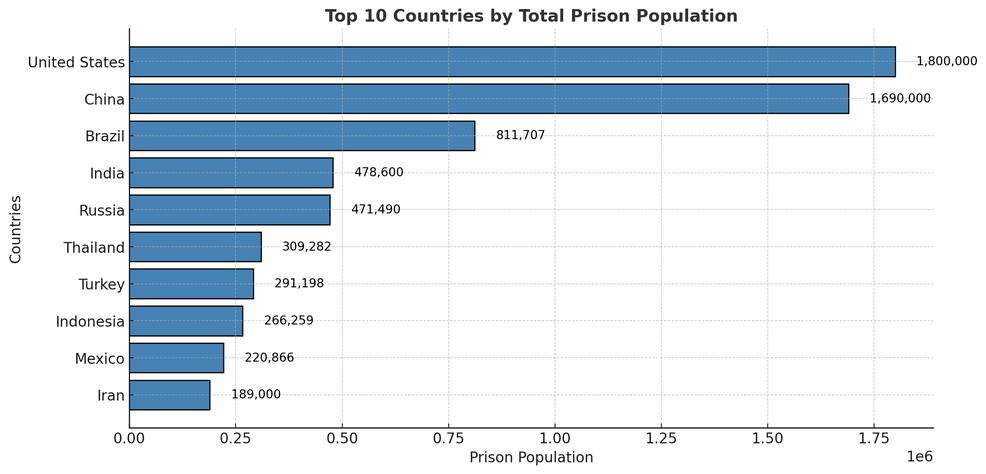
As societies worldwide grapple with the complexities of criminal justice, new data on global incarceration rates underscore the urgent need for evidence-based reforms. While much focus has been placed on incarceration rates per capita, an examination of absolute prison populations presents an even starker picture of mass incarceration.
Top 10 Countries by Total Prison Population
| Rank | Country | Total Prison Population | Incarceration Rate (per 100,000) |
|---|---|---|---|
| 1 | United States | 1,800,000 | 531 |
| 2 | China | 1,690,000 | 119 |
| 3 | Brazil | 811,707 | 320 |
| 4 | India | 478,600 | 41 |
| 5 | Russia | 471,490 | 320 |
| 6 | Thailand | 309,282 | 445 |
| 7 | Turkey | 291,198 | 355 |
| 8 | Indonesia | 266,259 | 96 |
| 9 | Mexico | 220,866 | 174 |
| 10 | Iran | 189,000 | 228 |
The United States Leads in Incarceration
With an estimated 1.8 million individuals behind bars, the United States remains the global leader in absolute incarceration numbers. Despite housing only 4% of the world’s population, the U.S. imprisons over 20% of the world’s incarcerated individuals. This stark disparity raises pressing questions about the effectiveness of punitive justice policies and their impact on recidivism.
A Global Crisis of Mass Incarceration
While the United States often receives criticism for its prison system, other nations, including China, Brazil, and Russia, also maintain substantial prison populations. China, the second-highest incarcerator, holds an estimated 1.69 million prisoners, despite a significantly lower incarceration rate per capita. Meanwhile, Brazil, facing a long-standing crisis of prison overcrowding, now imprisons over 800,000 individuals, exacerbating concerns about human rights violations and inadequate rehabilitation programs.
Reforming the Approach to Justice
The high levels of incarceration worldwide indicate that punitive approaches alone fail to address the root causes of crime. Instead, investing in evidence-based reforms—such as restorative justice, rehabilitation, and alternative sentencing—offers a more effective path toward reducing recidivism and improving civil society.
Countries like Norway, which prioritizes rehabilitation over punishment, have seen significantly lower recidivism rates and crime reductions. In contrast, systems that rely heavily on prolonged imprisonment tend to perpetuate cycles of crime and economic disenfranchisement.
A Data-Driven Path Forward
Fixing mass incarceration requires a commitment to data-driven policies that prioritize rehabilitation and reintegration over punitive measures. Governments worldwide must reconsider their reliance on imprisonment and instead invest in education, mental health services, and economic opportunities as long-term solutions to crime.
For policymakers, advocates, and citizens alike, these statistics serve as a clarion call: true justice lies not in the number of prisons built but in the opportunities provided to prevent incarceration in the first place.
FixingBOP.org remains committed to advocating for prison reform grounded in evidence-based policies, reduced recidivism, and a fairer, more just society.