BOP Begins Transition to CICLOPS: A Long-Overdue Modernization of Its Core Inmate Management System
BOP Begins Transition to CICLOPS: A Long-Overdue Modernization of Its Core Inmate Management System
Category: BOP History & Decline / Rehabilitation Programs: Lost Opportunities
Published: August 2026
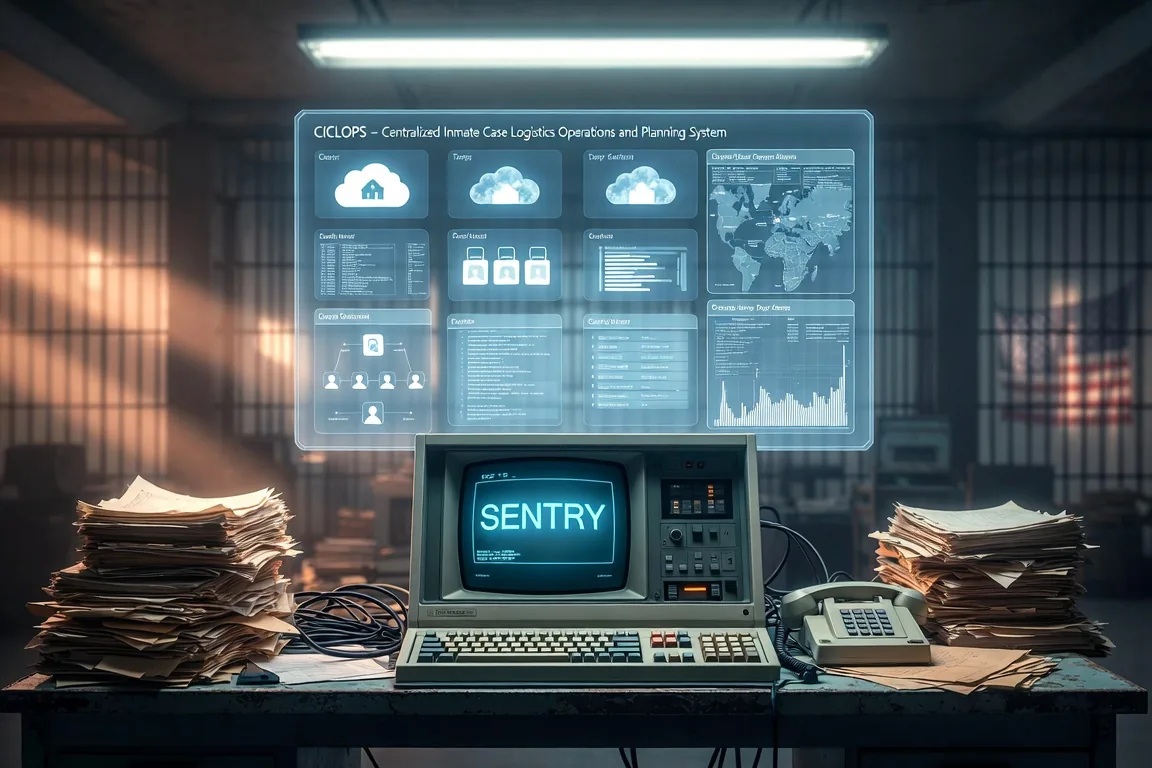
For decades, the Federal Bureau of Prisons has relied on SENTRY — an aging, COBOL-and-Assembler-based inmate case management system that has become a symbol of the agency’s technological stagnation. That era is finally beginning to end. The BOP has begun the transition to its long-promised replacement: CICLOPS, the Centralized Inmate Case Logistics Operations and Planning System.
CICLOPS is not a minor upgrade. It is a full modernization of the Bureau’s central nervous system for managing the approximately 150,000+ people in federal custody. The new platform is designed to replace SENTRY’s outdated architecture with a modern JavaEE-compliant application suite, built on a microservices architecture and hosted in the Bureau’s FedRAMP-certified AWS GovCloud environment. The goal is greater flexibility, better data accuracy, improved interoperability with partner agencies, and the ability to finally implement basic functions that SENTRY’s ancient programming language simply could not support.
The Contract Behind the System
In September 2021, the Bureau awarded Delivery Order 15BNAS21FRCA00031 (under the Alliant II government-wide acquisition contract) to International Business Machines Corporation (IBM) for “SENTRY Modernization and Cloud Migration Services.” The contract’s original ceiling was in the range of roughly $49–67 million, with options extending the period of performance into the early 2030s. IBM was tasked with converting the legacy COBOL and Assembler code into modern applications, enabling horizontal and vertical scaling, and migrating the entire system to the cloud.
Public GAO and Department of Justice Office of Inspector General reports have referred to the resulting system simply as CICLOPS. The formal name — Centralized Inmate Case Logistics Operations and Planning System — reflects its intended scope: designations and transfers, sentence computation, risk-and-needs assessments under the First Step Act, Central Inmate Monitoring (CIM) cases, and the broader logistics of inmate movement and case management.
Why This Matters
SENTRY’s limitations have had real-world consequences. One of the most glaring examples involves the First Step Act’s requirement that the Bureau place inmates, to the extent practicable, within 500 driving miles of their primary residence. SENTRY could only calculate straight-line (“as the crow flies”) distances. The result: official reports to Congress systematically undercounted how many people were housed far from home. OIG audits found that roughly 40 percent of the evaluated population sat more than 500 driving miles from their release residences — a figure the old system could not accurately capture.
BOP officials have stated that once CICLOPS is fully operational (targeted for late 2026, with some references pointing to September or December), the new system will finally support driving-mile calculations and other long-needed enhancements. The transition is being rolled out in waves to reduce risk and allow for feedback — a cautious approach that, given the Bureau’s track record with technology projects, is both understandable and concerning.
A Familiar Pattern of Delay and Under-Delivery
Readers of this site will recognize the pattern. The Bureau has repeatedly struggled with technology initiatives that promised modernization and delivered frustration. The tablet program remains a case study in missed opportunities: devices that could have delivered robust educational content, reentry tools, and meaningful family connection instead became limited platforms constrained by bureaucracy and vendor priorities. The First Step Act itself has been treated more as an administrative burden than a mandate for genuine rehabilitation.
CICLOPS arrives against this backdrop. On paper, it addresses critical shortcomings. In practice, success will depend on whether the Bureau treats the new system as a tool for better case management and closer-to-home placements — or simply as another expensive platform that continues to prioritize institutional convenience over the statutory rights and rehabilitation needs of the people in its custody.
The transition has begun. The real test is whether CICLOPS becomes the foundation for a more rational, data-driven, and humane federal prison system — or just the latest chapter in the long story of BOP modernization that never quite materializes.
Sources
- U.S. Department of Justice Office of the Inspector General, "Audit of the Federal Bureau of Prisons' Efforts to Place Inmates Close to Home (25-083)," September 2025.
- U.S. Department of Justice Office of the Inspector General, "Audit of the Federal Bureau of Prisons' Efforts to Place Inmates Close to Home (25-083), full report," September 2025.
- Federal Bureau of Prisons, "BOP Brings Decades Old Systems Into a Modern Era," August 27, 2026.
- USAspending.gov, "SENTRY Modernization and Cloud Migration, Delivery Order 15BNAS21FRCA00031," September 2021.
- U.S. Government Accountability Office, "Federal Prisons: Improvements Needed to the System Used to Assess and Mitigate Risks (GAO-26-107268)," January 2026.
- FedScoop, "Federal Bureau of Prisons seeks to further update its inmate management system," May 2018.
- Federal Bureau of Prisons, "Privacy Impact Assessment for the SENTRY Inmate Management System," July 2012.