Texas Prisons Get an Air Conditioning Deadline. Federal Prisons Get a Guideline.
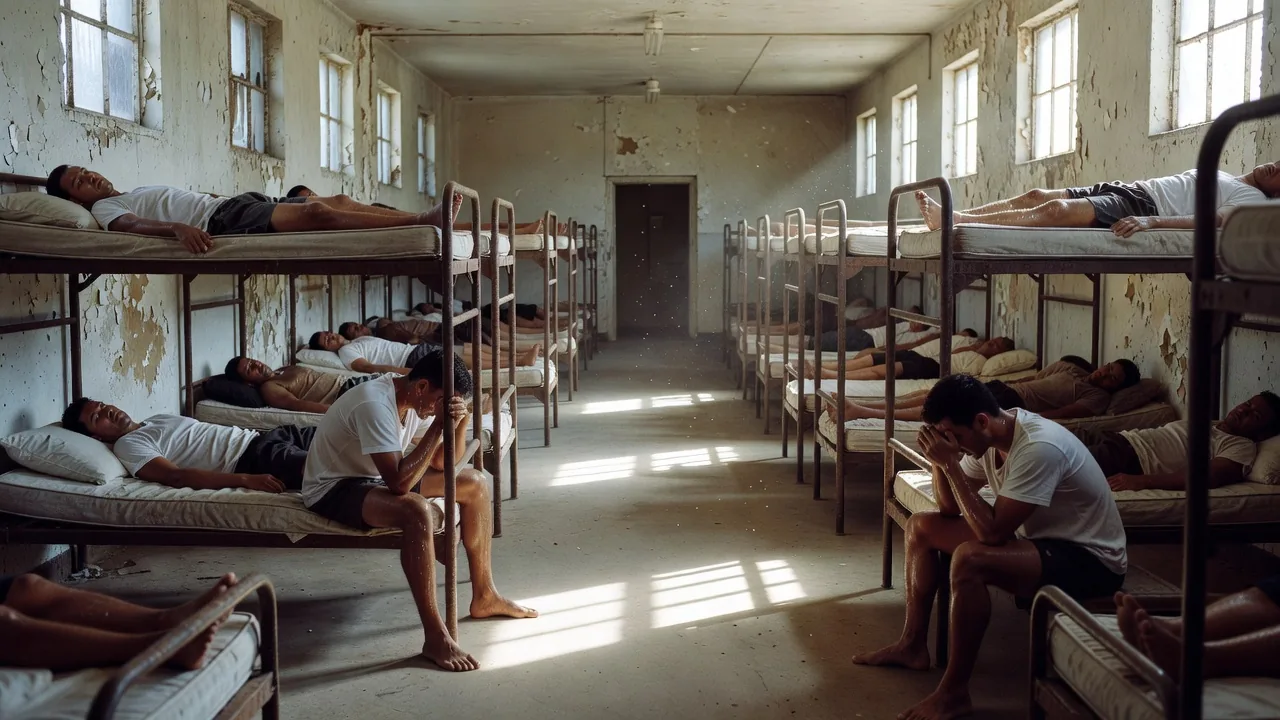
On September 22, U.S. District Judge Robert Pitman ruled that Texas prisons without air conditioning violate the Eighth Amendment and ordered the Texas Department of Criminal Justice to install it in every state prison by December 31, 2029. TDCJ says it will appeal, and puts the cost at about $1.5 billion.
The order runs 150 pages, and most of its evidence comes from the agency’s own records. TDCJ’s indoor temperature logs show un-air-conditioned housing above 85 degrees nearly every day from May 1 through September 30. Outdoor heat indexes near its units have reached 134 degrees. Garza West recorded 100 degrees indoors on August 29, 2025 and stayed below 95 degrees at its 3 p.m. reading on only three days that month. Dalhart, the northernmost unit in the system, logged 85 degrees or higher for twelve days in a fourteen-day stretch in August 2025.
At trial the agency counted 52,438 “cool beds,” its term for beds in proximity to full or partial air conditioning. That is about 37 percent of the people it holds, which left roughly 88,697 in housing without it going into the summer of 2026. By September 1, TDCJ reported 53,676 cool beds. That is 1,238 more than at trial, a pace the judge found has not kept up with the growth of the prison population.
The death count in the order is the part TDCJ has contested for years. The agency has acknowledged 23 heat-related deaths between 1998 and 2012, ten of them in the summer of 2011, and three more in 2023. Pitman found credible evidence of at least six additional deaths from 2023 through 2025. He also wrote that the real number is unknown, because heat usually kills by worsening something else rather than by being the listed cause.
He did not entertain the budget argument. “Defendant is advised that financial considerations will not be considered a legitimate reason for his failure to comply with this Court’s order.” The remedy is a plan, installation complete by the end of 2029, and a status report to the court every six months, with the first due March 22, 2027. He found deliberate indifference in the failure of Director Bobby Lumpkin’s agency “to enact a meaningful, committed plan to install air-conditioning on the timeline that TDCJ has repeatedly indicated is possible.”
TDCJ’s response was that it has “robust heat mitigation efforts in place” and that it disagrees with the finding. It expects 60,000 cool beds by the end of this year and 90,000 in 2028, against a prison population projected to top 150,000. The agency asked the Legislature for $289 million for air conditioning this cycle, less than half of the $774.3 million it told the court it could obligate, a gap the judge quoted back at it.
One detail from the ruling is worth carrying forward. Texas law already sets a temperature range for county jails, 65 to 85 degrees. Its prisons have no such rule. That is the same gap the federal system has, and the order does not touch it.
The order stops at the state line
Nothing in Pitman’s ruling binds the Bureau of Prisons. It is a judgment against one state agency, and the federal prisons in the same heat answer to a different set of rules: the agency’s own policy and the Eighth Amendment, enforced one lawsuit at a time.
Just outside Dallas, FCI Seagoville holds men in a complex that opened in 1940. In August 2023, the Fort Worth Star-Telegram reported what that meant in a record heat wave. Four of its seven housing buildings, all built in the 1940s, had no air conditioning. The other three had it, along with frequent power failures, and four housing units ran on rented generator power from mid-December to the end of July.
People inside reported temperatures of at least 110 degrees in the un-air-conditioned units that August, with thermometers on the first and second floors reading 90 and 100. One man said it was so hot inside that going outside cooled him off. They described men passing out and having seizures, long lines for cold showers, and small desk fans sold at the commissary for $30.70. The union president at the prison called the facility “duct tape and band-aids” and said it was operating at about half the staff it needed.
The Bureau’s answer at the time was that everyone at Seagoville had access to “either air conditioning or fans,” that supervisors conducted daily temperature checks, and that there had been “no inmate health concerns, including fainting or injuries, attributed to heat conditions.” It declined to release the temperature data.
In May 2025, Rep. Jasmine Crockett described the facility to a House Judiciary subcommittee in her opening statement: “Six of the eight buildings housing inmates had broken air-conditioning units during the summer where temperatures in Texas facilities can reach up to 110 degrees, and at least one unit topped 149 degrees.”
What a federal prison gets instead of a deadline
There is no statute that requires the Bureau of Prisons to hold its facilities at any particular temperature. Policy sets a target of 76 degrees in summer, with a qualifier: the inspector general’s office quotes it as saying that “occupants may experience a range of temperatures in their space that is a few degrees on either side of the targeted set point.”
The Bureau’s clinical guidance on heat-related illness is more explicit about who owns the problem. It lists hydration, acclimatization, and restrictions on outdoor work as mitigation, then hands the hardware question to the wardens: “Environmental controls to monitor for and lower excessively high temperatures in non-air-conditioned housing and work areas are to be determined by each institution.”
That is where the inspector general keeps finding failures. During a July 2025 site visit to FCI Terre Haute, OIG staff measured 79 to 89 degrees in housing units and common areas while outside highs were 92 and 93, with humidity between 62 and 94 percent. The Bureau’s own guidance notes that evaporation stops cooling the body above 75 percent humidity. Earlier inspections found the same pattern at MDC Brooklyn in 2019 and FCI Lewisburg in 2024: temperatures outside the ranges BOP policy sets, and no reliable method for measuring them.
A May 2023 audit of the Bureau’s maintenance and construction put the numbers on the backlog. The system’s estimated need for heating, ventilation, and air conditioning work was $212 million, against $64 million allotted. At FCI Terminal Island, built in 1938, all but two housing units had no air conditioning, and adding it was estimated at roughly $34 million. The auditors’ summary of that finding: “the absence of air conditioning in inmate housing is notable.” The broader repair backlog across the Bureau’s 122 institutions was $3 billion as of 2025, and the audit’s recommendations were still open.
What the Bureau told Congress
On August 11, 2025, Reps. Alma Adams, Jasmine Crockett, Lucy McBath, and Ayanna Pressley sent a letter signed by 40 House Democrats to then-Director William Marshall, asking how the Bureau tracks temperatures, heat illness, and HVAC failures. The reply, as the Prison Policy Initiative reported, was that nearly 19,000 people in Bureau custody reported heat-related illness between January 2022 and September 2025, and that more than 40 were diagnosed with heat stroke.
Adams and McBath followed with a request for a GAO study on February 27, 2026, asking eight questions that amount to whether anyone at the Bureau knows how hot its housing units get or what happens when the systems fail. GAO launched the study in March. In July, the two introduced H.R. 9591, the Extreme Temperatures Injustice in Prisons Act, which would fund climate control installation and upgrades across the federal system within five years, require temperature monitors in every cell and workspace, set heat and cold standards, provide free cooling and warming supplies when temperatures turn dangerous, and require public reports on HVAC progress and temperature-related illness. It has been referred to committee.
What would close the gap
The cheap half of this is a drafting change. The Bureau already names 76 degrees as its summer target. Striking the qualifier and requiring that housing unit temperatures be recorded and published would cost nothing, and it would turn the inspector general’s spot measurements into a number that can be checked every month.
The expensive half is appropriations. The HVAC need the auditors identified in 2023 was $212 million. Terminal Island alone needs about $34 million to air condition five housing units. The full repair backlog is $3 billion, and the Bureau has spent years asking for less than it says it needs. H.R. 9591 is the vehicle that would authorize the spending and the monitoring together, and until it moves, the only federal obligation is a target with an escape hatch.
The Texas order does not fix any of that. What it does is settle three things a federal rule or a federal case would need: un-air-conditioned housing in this heat violates the Eighth Amendment, ice and cool rooms and heat scores are not a substitute for cooling, and a court can put a date on the work. Seagoville sits in the same heat index as the units Pitman just ruled on, under a policy that permits a few degrees in either direction. As Amite Dominick of Texas Prisons Community Advocates put it after the ruling, “An order on paper is not the same as relief in a cell.”
Sources
- U.S. District Court for the Western District of Texas, "Lioness, et al. v. Lumpkin, No. 1:23-cv-01004-RP, Order," September 22, 2026.
- Texas Tribune, "Federal judge orders Texas to air condition all prisons by the end of 2029," September 22, 2026.
- Texas Department of Criminal Justice, "Air Conditioning Program," accessed October 4, 2026.
- Fort Worth Star-Telegram, "Temperatures rise at Seagoville federal prison in North Texas," August 31, 2023.
- U.S. House Judiciary Subcommittee on Crime and Federal Government Surveillance, "Federal Corrections in Focus: Oversight of the Bureau of Prisons," hearing transcript, May 6, 2025.
- U.S. Department of Justice Office of the Inspector General, "Notification of Concerns Regarding Conditions at Federal Correctional Institution Terre Haute, Management Advisory Memorandum 26-001," October 2025.
- U.S. Department of Justice Office of the Inspector General, "Audit of the Federal Bureau of Prisons' Efforts to Maintain and Construct Institutions," May 2023.
- Federal Bureau of Prisons, "Prevention and Management of Heat-Related Illness," clinical guidance, December 2017.
- Prison Policy Initiative, "Prison Policy Initiative endorses the Extreme Temperatures Injustice in Prisons Act," July 16, 2026.
- U.S. House of Representatives, "H.R. 9591, Extreme Temperatures Injustice in Prisons Act of 2026," introduced July 6, 2026.
- Reps. Alma S. Adams and Lucy McBath, "Request for a GAO study on extreme temperatures in federal prisons," February 27, 2026.