The BOP Has a First Step Act Office Now. The Tablets Could Make It Matter.
The Bureau of Prisons now has a dedicated First Step Act Office, reporting directly to the Director, that will own the law’s time credits and its programming across the entire prison system. It will sit in two places: Central Office in Washington and the Designations and Sentence Computation Center in Grand Prairie, Texas, the same center that computes federal sentences and decides where people serve them.
The Bureau’s release lists what the office will do. It will administer and calculate First Step Act time credits, coordinate evidence-based recidivism reduction programming, and make sure productive activities are available. It will write policy guidance and training, monitor compliance with the statute, manage the budget, evaluate outcomes, and send technical assistance to institutions and regional offices.
Director William K. Marshall III said the office will “provide the focused leadership and coordination necessary to maximize opportunities for inmates in our custody to participate in evidence-based programming and earn time credits toward earlier release to prerelease custody or supervised release.” Rick Stover, a special assistant to Marshall, said centralizing oversight in one office would let the Bureau “respond more effectively to questions and concerns from inmates, their families, and advocacy groups who are navigating the First Step Act process.”
The record it inherits
The Justice Department’s inspector general spent two years on how the Bureau spent the $1.23 billion Congress gave it for this law. Report 26-057, published in May, is blunt about the money. The Bureau used $258.7 million of it between October 2022 and December 2024 to provide free telephone minutes, which the law allows as an incentive for program participation, and gave the minutes to everyone in custody instead. The report says it did so “without clear authority to do so,” then reimbursed itself roughly $106 million more than the cost it had calculated, moving funds tied to a single fiscal year into a trust account with no time limit on spending. Nearly $120 million went to the Labor Department for a vocational grant program the Bureau then barely monitored, and $16.8 million of the fiscal 2022 appropriation was still unspent as of April 2026.
The programming findings are the ones that matter here. Institutions offered “significantly fewer FSA programs than anticipated” because of limited staff, a lack of instructional space, and lockdowns that kept people in their units. At many institutions, hundreds of people sit on program waitlists, “often for multiple years at a time.” The Government Accountability Office found the same shape of problem in January: assessment deadlines missed, program participation records inaccurate enough that the Bureau cannot tell whether it offers enough programming to meet the needs it has assessed, and time credits generally applied toward supervised release but not toward prerelease custody.
A quarter of them completed nothing. That is not the scandal.
Both oversight reports land hard on one number. Of the 41,548 people released early on earned time credits between fiscal 2022 and fiscal 2024, 9,819 of them, 24 percent, had completed no First Step Act program at all. The inspector general calls the outcome “inconsistent with FSA goals” and names the cause: Bureau policy lets credits keep accruing for people who express a willingness to participate or who join a waitlist, “even when those programs are unavailable.”
We read that differently, and the way the number gets framed is wrong. The Bureau cannot staff the classes it promised, so it lets people earn the credit anyway. That is the right call, and the alternative would punish people for the Bureau’s failure. A person who signs up for every program their assessment calls for, completes everything that opens up, and spends two years on a waitlist for the one course they actually need has done everything within their own power. Congress wrote an incentive for effort. Making the credit turn on whether the Bureau happened to staff the right classroom at the right facility in the right quarter would convert that incentive into a lottery.
What else earned those credits
Coursework is one input into a credit system with several, and it is not the one the statute leads with. Time credits pay ten days for every thirty days of successful participation in recidivism reduction programming or productive activities, plus an additional five days per thirty for a person the Bureau assesses at minimum or low risk who has not increased their risk across two consecutive assessments.
Productive activity has a statutory definition of its own, and the Bureau’s regulation spells out what counts: prison work and employment, academic classes, vocational training, mentoring, faith-based classes, civic engagement, restorative justice, trauma counseling, life skills. A man who held a job on the unit for four years earned credit for all of it, whether or not he ever sat in a classroom.
The disciplinary record runs through the machinery the same way. A person in the special housing unit, on a writ, in a hospital or on a mental health hold is generally not counted as “successfully participating,” so the clock stops. Credits can be lost for violating program rules, and restoring them requires “clear conduct,” behavior free of disciplinary infractions, across two consecutive risk and needs assessments. The older good conduct credit, up to 54 days off the sentence for each year, turns outright on “exemplary compliance with institutional disciplinary regulations,” and the Bureau is required to weigh progress toward a high school diploma or its equivalent when it awards that credit. Staying out of trouble is not a footnote in this system. It is paid behavior.
So the count of 9,819 needs a different frame. None of them needed a completed class to earn the credits they walked out with. Many worked, mentored, stayed clean for years, and held a minimum or low risk assessment the Bureau kept confirming. Calling that a failure to complete “a single FSA program” measures the Bureau’s catalog, not the person.
None of that makes the delivery problem smaller. That is the other finding in both reports, and it is the one the tablets can answer.
The tablets are the delivery system
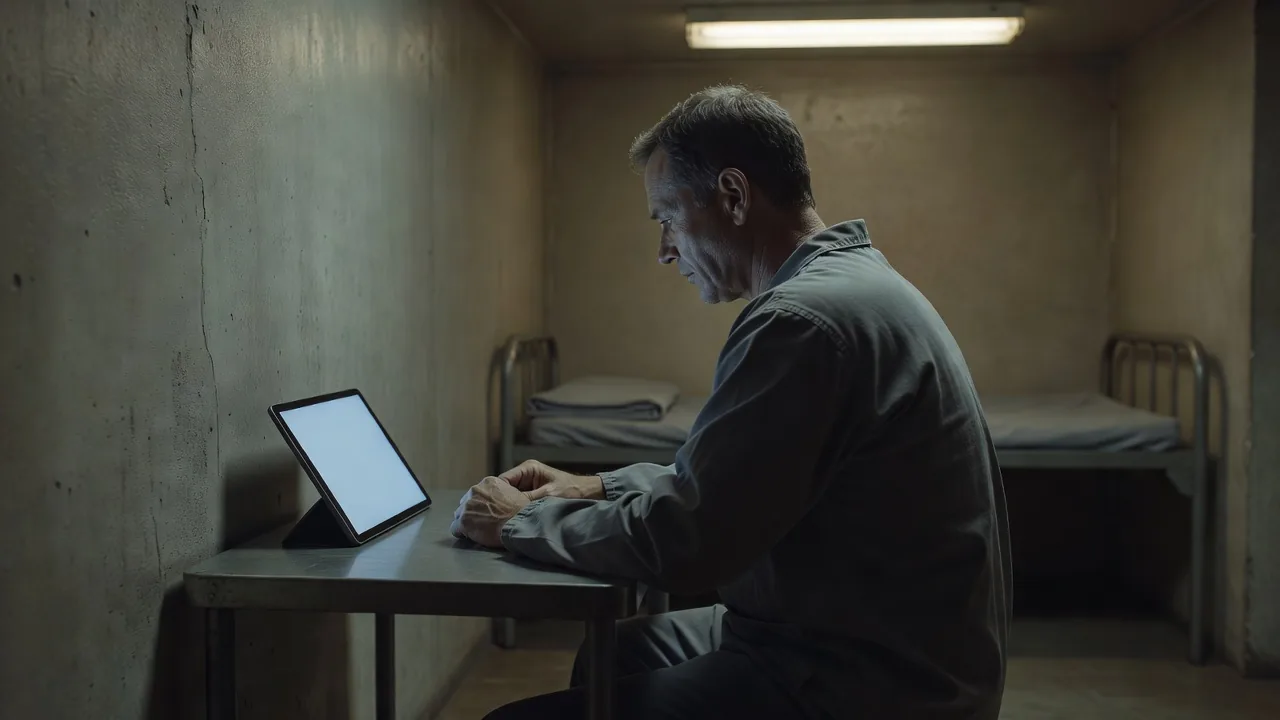
On July 8 the Bureau awarded Securus the inmate tablet contract, a phased rollout meant to put a corrections-grade device in front of everyone in custody. The features the Bureau listed include academic coursework and literacy support, career and technical training modules, and evidence-based programs. It also moves program registration off paper, which is where it lives now.
Three things follow from that, and they answer the oversight findings directly.
Courses can keep running when the classroom is closed. Lockdowns, staff shortages, and missing instructors are the reasons the inspector general gives for the program gap. None of them stop a person from working through a module in their cell, and attendance stops being a logistics problem.
Participation and completion get tracked by the platform instead of typed in by whoever is available. That is the data the inspector general says does not exist: the Bureau cannot currently say how often a given program is offered at a given institution, and GAO found the participation records unreliable enough that the agency cannot determine whether its programming is sufficient. A tablet that logs every lesson opened and finished produces that dataset as a byproduct.
The binding constraint shifts. Right now a program has to physically exist at the facility where a person is locked up. On a device the catalog travels, and the only remaining question is what the Bureau approves.
The obstacles are real, and they are engineering problems rather than policy ones. Charging devices during extended lockdowns, cells with no outlet, network capacity, content approval, and the price of anything the vendor sells on top of the coursework. We have written about the gaps in that contract, and they have not closed. None of them require an act of Congress to solve, and none of them justify keeping the paper classroom as the only route to a credit.
What the office should do with the data
This is where a dedicated office stops being a filing cabinet. With tablet telemetry, one office can see what people attempt, where they quit, which modules get finished, which facilities cannot get anyone through a course, and which content lands flat. That is how the large online course platforms operate: they measure, rewrite, and measure again. The Bureau has never had that loop, and it is the difference between counting completions and improving outcomes.
The Bureau can already pull participation, completion and waitlist counts out of its own inmate records, as the inspector general describes. What it cannot pull is how often a program was offered anywhere. Publishing the first set costs nothing, and a report that broke credits down by category, including hours worked and assessments held, would end the impression that the only credit worth counting comes from a classroom.
It is also what the inspector general asked for. Recommendation six is to collect data on how often each program is offered at each institution. Recommendation seven is to fix the public program guide so it stops describing availability the institutions do not have. Both become feasible the moment the coursework runs on a tracked platform, and both should be designed into the rollout rather than bolted on after it.
The part nobody says out loud
A classroom inside a prison is rarely a good place to learn. The inspector general described what the Bureau is working with: a psychology department at FCI Talladega and another at FCI Phoenix, each with a single dedicated classroom, borrowing space from other departments when they can get it, and a vocational workshop at Phoenix whose ceiling was too low to build full-size framing, so people practiced on scaled-down structures.
The bigger obstacle is who is watching. Stigma around education plays out hardest in a group setting. In certain cultures, and among plenty of men who never finished school, sitting in a unit classroom with a workbook in hand is something to be seen avoiding. Someone who will not raise a hand in front of thirty people will work through modules alone at night. Individual learning routes around the audience, and the audience is half of what keeps people out of the room.
That is an argument for the tablet that has nothing to do with cost or lockdowns. It reaches people the classroom never will.
The time credits rule takes effect September 30, and comments close the same day on the docket where people have been asking the Bureau how a person is supposed to earn credits when there is nothing to complete. The office reports to the Director, the tablets are already under contract, and the rollout has not started. Building the tracking and the reporting into that rollout is the cheapest test of whether this office changes anything.
Sources
- U.S. Department of Justice, Federal Bureau of Prisons, "Federal Bureau of Prisons Establishes Dedicated First Step Act Office to Enhance Implementation and Oversight," September 24, 2026.
- U.S. Department of Justice, Office of the Inspector General, "Evaluation of the Federal Bureau of Prisons' Use of First Step Act Funding and Implementation of First Step Act Programs at Its Institutions," Report 26-057, May 2026.
- U.S. Government Accountability Office, "Federal Prisons: Improvements Needed to the System Used to Assess and Mitigate Incarcerated People's Recidivism Risk," GAO-26-107268, January 27, 2026.
- U.S. House of Representatives, Office of the Law Revision Counsel, "18 U.S.C. § 3632, Evidence-Based Recidivism Reduction Program Incentives and Time Credits," current as of September 20, 2026.
- Electronic Code of Federal Regulations, "28 CFR Part 523, Subpart E: First Step Act Time Credits," current as of September 20, 2026.
- U.S. House of Representatives, Office of the Law Revision Counsel, "18 U.S.C. § 3624, Release of a Prisoner," current as of September 20, 2026.
- U.S. Department of Justice, Federal Bureau of Prisons, "Federal Bureau of Prisons Awards Transformational Inmate Tablet Contract to Modernize Communication, Education and Rehabilitation Services," July 8, 2026.
- Federal Register, "First Step Act Time Credits—Revisions (interim final rule)," August 31, 2026.